Why NEMT reliability matters
NEMT is how many Medicaid patients get to care. In fiscal year 2018, "approximately 3.2 million Medicaid beneficiaries used NEMT," with "over 60 million NEMT ride-days," according to MACPAC's June 2021 report to Congress. Focus group participants told MACPAC that without these services "they would have no other way to get to their medical appointments."
Transport gaps are common. A study of national survey data in the American Journal of Public Health found that "in 2017, 5.8 million persons in the United States (1.8%) delayed medical care because they did not have transportation."
Dispatch software doesn't change those numbers on its own. Its job is narrower: make sure each booked ride has a driver, a route and a complete record.
The problem NEMT operators bring us
NEMT operators usually run the office and the road on separate tools, and every gap costs money.
Before the build, the NEMT company we worked with had dispatchers juggling trip bookings, driver assignments, wait-time fees and facility billing across separate tools. Drivers had no app built for their day. Every late pickup or no-show had a cost, and the paperwork behind each trip, such as proof of delivery, inspections and documents with expiry dates, was hard to keep complete.
They wanted one system for the office and the road, and a way for staff to ask questions about today's trips without digging through screens.
What we built for a NEMT operator
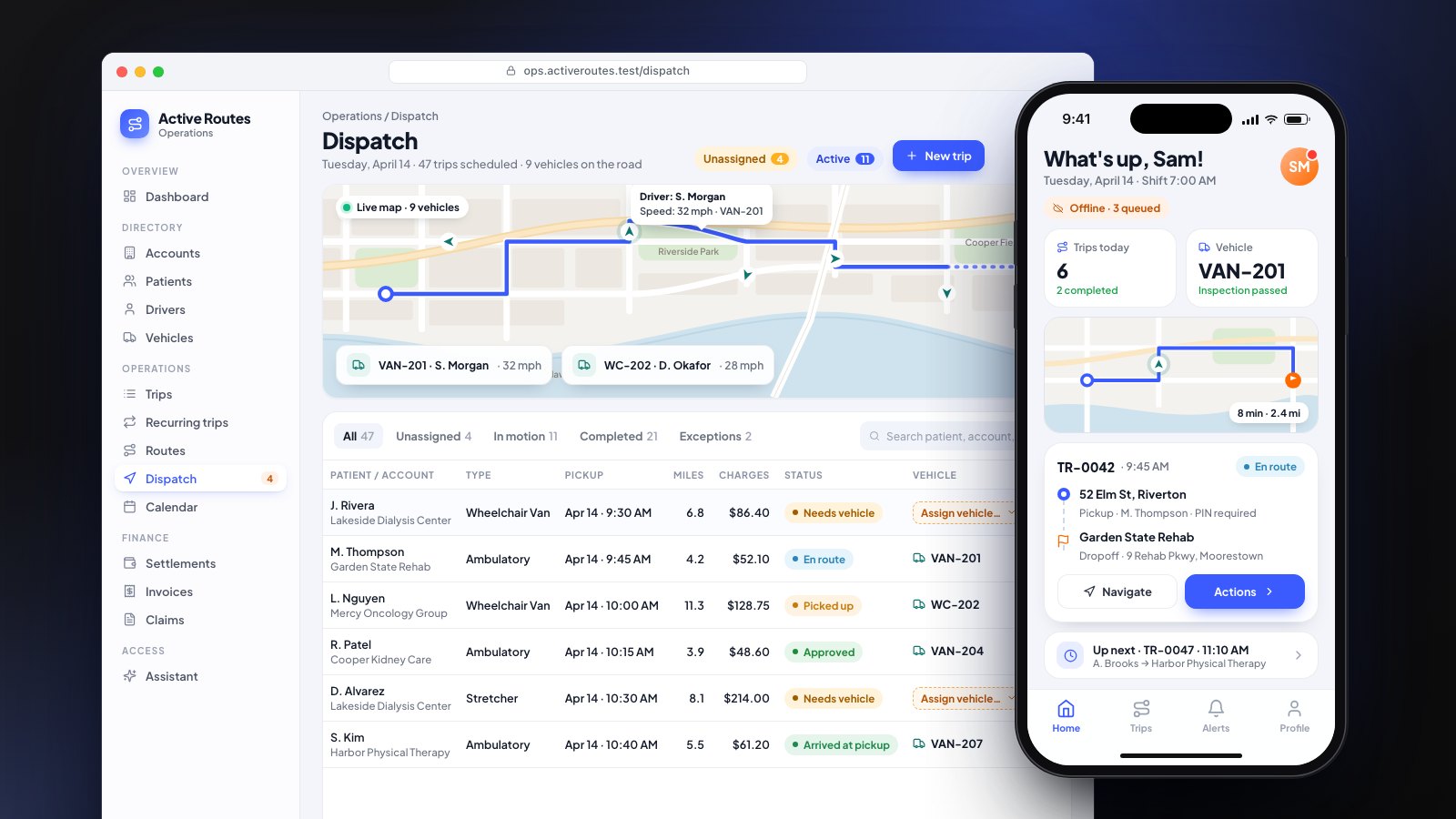
We built a web platform for the office, a Flutter app for drivers and an AI assistant over live trip data. It's client work, described in full in the NEMT dispatch platform case study.
Office platform
- Accounts with their own rate cards, plus patients and vehicles
- A dispatch board with a live map, routes and recurring trips
- Billing: invoices and statements, and driver settlements
- Compliance documents with expiry alerts
- A fixed set of trip statuses with a full history, so every trip can be traced
- Edit protection, so two dispatchers can't overwrite each other's changes
Driver app
- Today's trips and route
- Pre-trip inspections
- Geofenced arrival
- Photo proof of delivery
- An offline queue that syncs when signal returns
AI assistant
The assistant is built on the Laravel AI SDK and answers staff questions through ten read-only tools over live trip data. Staff can ask which trips are running late and get an answer from what the system holds.
The stack is Laravel 13, React 19, Flutter, OpenAI through Laravel AI, and Stripe.
Why an AI assistant helps NEMT dispatchers
An assistant saves dispatchers from clicking through screens to answer routine questions about the day.
- It looks before it answers. Every answer comes from a tool that queries the live system.
- It can't change trips. The tools in this build are read-only. If you want the assistant to take actions, such as drafting a booking, those go to a person for approval.
- It's logged. Every AI action is recorded, so you can see what was asked and what came back.
The right set of tools depends on how your office works. We decide them with you, and you can see how in AI agent development.
Already happy with your dispatch software? The NEMT dispatch assistant adds the same kind of assistant on top of it, with a $950 audit to check access first.
NEMT dispatch software or scheduling software?
Scheduling software books trips and builds a schedule. NEMT dispatch software does that and then runs the day: it assigns trips to drivers, tracks them on a live map, records pickups and drop-offs from the driver app, and turns completed trips into billing. If your team still re-keys trips between a scheduler, phone calls and a billing spreadsheet, you need dispatch software, not another scheduler.
Custom NEMT software or an off-the-shelf product?
Off-the-shelf NEMT software is often the right choice if your workflow matches how it works. A custom build makes sense when it doesn't.
Consider a custom build when:
- Each account or facility has its own rate card, and billing rules don't fit a template
- Wait-time fees, settlements and statements are worked out by hand today
- You want an AI assistant that answers from your own trip data
- You want to own the code, prompts and data, with code in your own repository from the start
If you already have dispatch software you like, you don't need to replace it. We can add an AI feature to it if its data is in a system we can reach.
Patient data and access
NEMT software holds patient details, so access is limited by design.
- The assistant reads through tools limited to what the signed-in person may see
- A model receives only what a task needs, and we never use your data to train models
- Every AI action is logged
We don't hold a healthcare compliance certification. If your contracts set rules for patient data, tell us at the start and we write how we'll meet them into the proposal. Read more on security and data.
Related builds
The same patterns show up in other work.
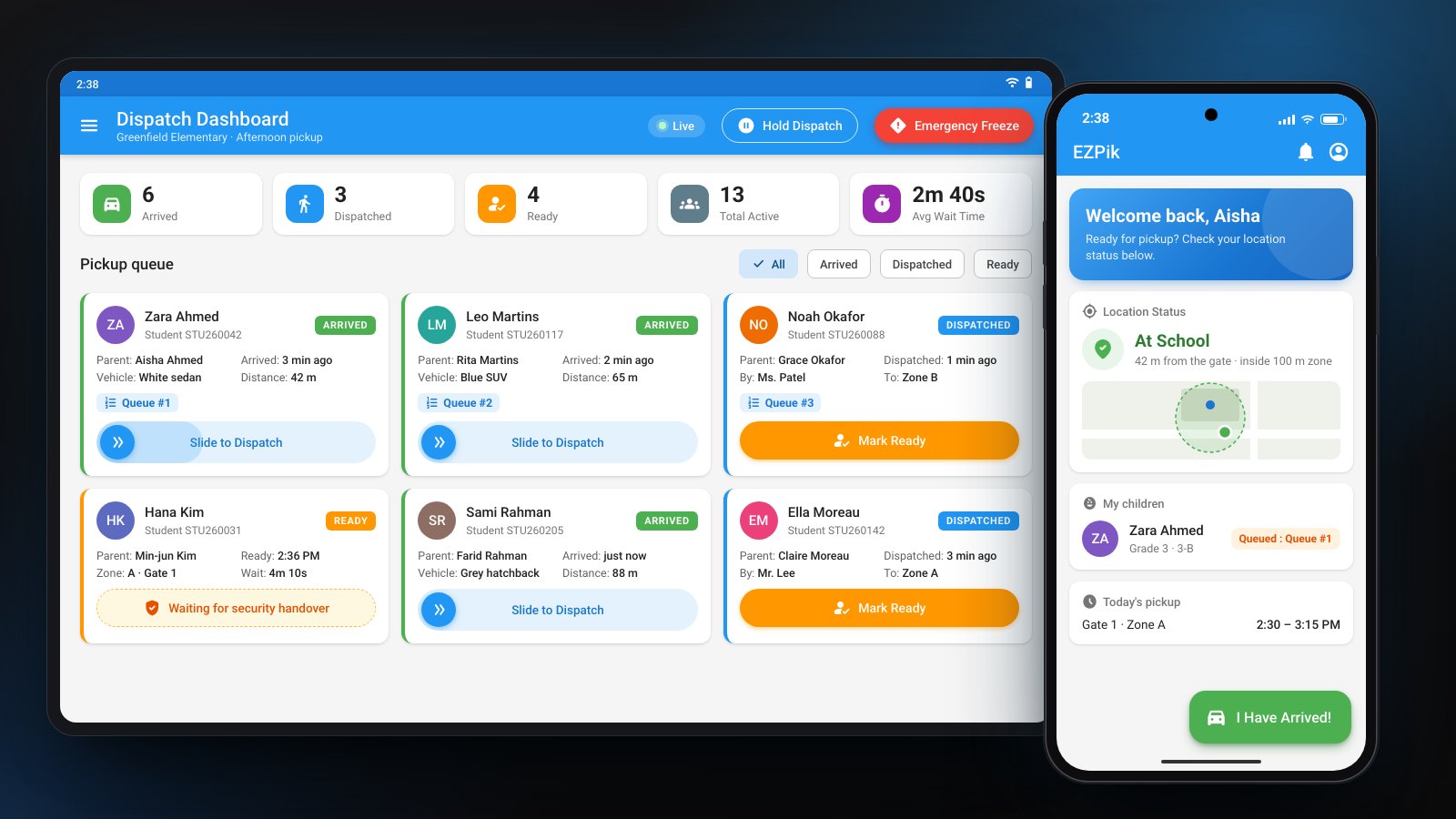
- Geofencing and Flutter apps: our school pickup safety system enables a parent's arrival only within 100 meters of the school.
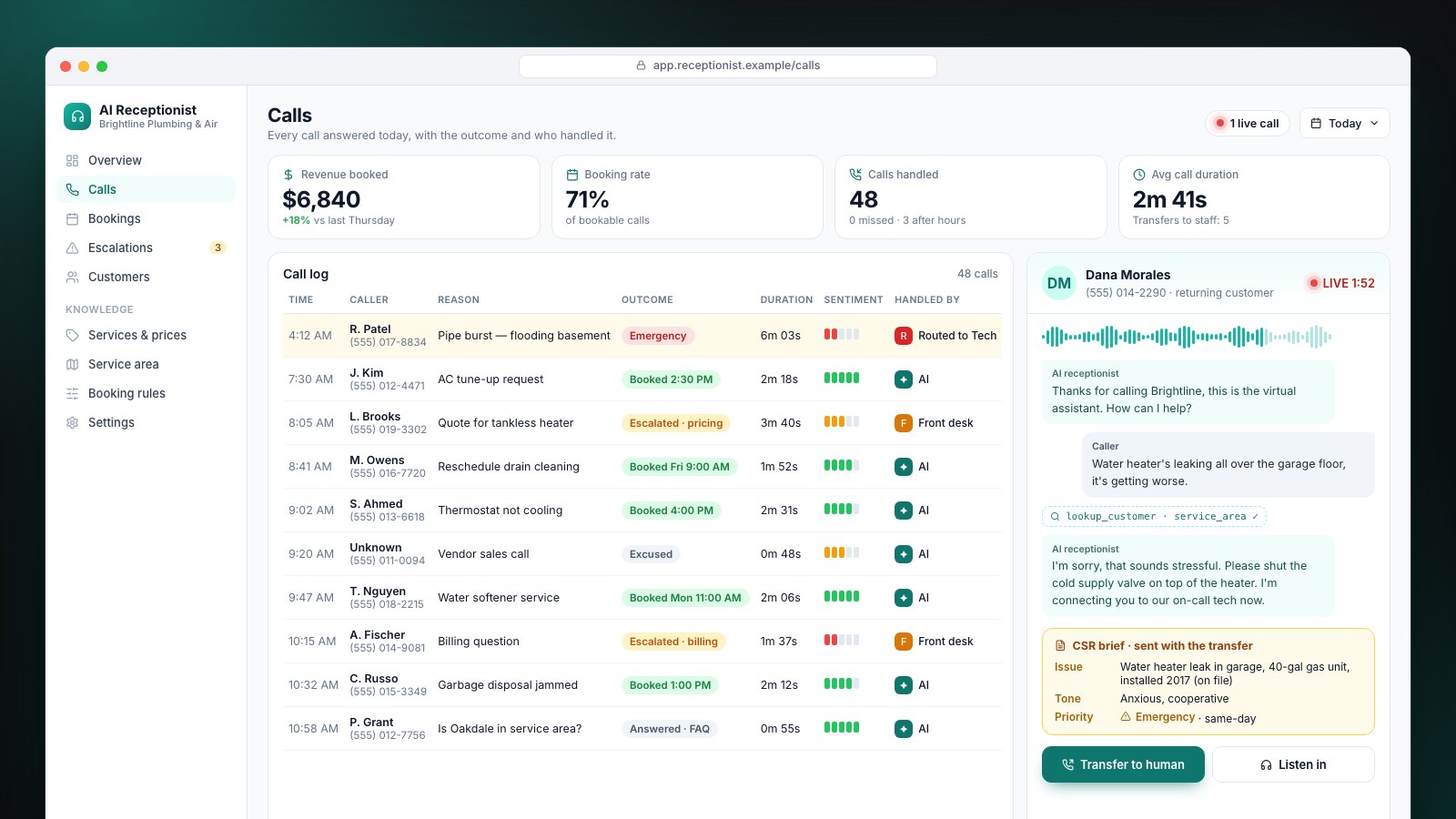
- Bookings by phone: our AI receptionist is a concept design that reuses the booking, notification and assistant patterns from this NEMT build.
Cost and timeline for NEMT software
Our prices are published, and you approve a fixed price before work starts.
- AI Workflow Audit, $950: two weeks to map one workflow, such as dispatch questions or billing, and get a fixed quote. Credited if you build within 60 days. See the audit.
- Feature Build, from $2,500: one AI feature added to software you already have.
- First AI Workflow, from $4,500: one agent connected to your systems, with tools, tests, logging and handover. Usually three to six weeks once the scope is signed.
- Extended Build, from $6,500: the agent plus an admin console or a Flutter mobile app, and more integrations.
A full platform like the one above is planned in phases, with something your team can use at the end of each one. See pricing for every plan.
Sources
- Medicaid and CHIP Payment and Access Commission (MACPAC), Mandated Report on Non-Emergency Medical Transportation, Chapter 5 of the June 2021 Report to Congress on Medicaid and CHIP
- Wolfe MK, McDonald NC, Holmes GM, Transportation Barriers to Health Care in the United States: Findings From the National Health Interview Survey, 1997-2017, American Journal of Public Health, 2020